
If your blood pressure remains high despite making healthy changes or taking medication, the problem may not be limited to what happens during the day. What happens while you sleep can affect your blood pressure too.
Sleep apnea repeatedly interrupts breathing during sleep. These interruptions can lower oxygen levels and trigger stress responses that cause your heart to work harder and your blood vessels to tighten. Over time, this can contribute to high blood pressure and make existing hypertension more difficult to control.
The connection is particularly important because many people have sleep apnea without realizing it.
Quick Answer
Yes. Sleep apnea can contribute to high blood pressure, especially when the condition is moderate to severe or untreated.
Obstructive sleep apnea causes repeated pauses or reductions in breathing during sleep. Each episode can lower oxygen levels and activate your body’s stress response, temporarily increasing heart rate and blood pressure. When this happens repeatedly night after night, it may contribute to persistently elevated blood pressure.
Sleep apnea is also associated with nighttime hypertension and resistant hypertension, which is blood pressure that remains above goal despite treatment with multiple medications.
Treating sleep apnea can improve sleep and overall health and may also help lower blood pressure in some people. However, sleep apnea treatment does not replace other treatments your healthcare provider has recommended for hypertension.
Key Takeaways
- Obstructive sleep apnea is a recognized secondary cause of high blood pressure.
- Repeated breathing interruptions can cause temporary surges in blood pressure throughout the night.
- Sleep apnea may prevent the normal drop in blood pressure that usually occurs during sleep.
- The condition is especially common among people with difficult-to-control or resistant hypertension.
- Loud snoring, gasping during sleep, daytime sleepiness, and morning headaches can be warning signs.
- Treating sleep apnea with CPAP or other appropriate treatments may help lower blood pressure, although the effect varies from person to person.
- If your blood pressure remains high despite treatment, asking your healthcare provider whether sleep apnea could be contributing may be worthwhile.
What Is Sleep Apnea?
Sleep apnea is a sleep disorder in which breathing repeatedly stops or becomes too shallow during sleep.
The most common type is obstructive sleep apnea, or OSA. It occurs when the muscles and tissues around the upper airway relax enough during sleep to partially or completely block airflow.
Your brain recognizes that you are not getting enough oxygen and briefly wakes you enough to reopen the airway. You may not remember waking up because these interruptions can last only a few seconds.
But the cycle can occur many times during a single night.
Instead of experiencing long periods of uninterrupted, restorative sleep, your body repeatedly shifts between sleeping, struggling to breathe, and briefly waking.
That process affects more than sleep quality. It can also place repeated stress on your cardiovascular system.
How Does Sleep Apnea Raise Blood Pressure?
Sleep apnea can affect blood pressure through several interconnected mechanisms.
Oxygen Levels Repeatedly Fall
When breathing stops or becomes restricted, the amount of oxygen in your blood can decrease.
Your body responds as though it is under stress. The sympathetic nervous system, which controls your “fight or flight” response, becomes more active.
Stress hormones are released, your heart rate may increase, and your blood vessels constrict.
The result can be a temporary increase in blood pressure.
Now imagine that process occurring dozens or even hundreds of times during the night.
Those repeated surges can eventually affect blood pressure during waking hours as well.
Your Nervous System Stays More Active
Normally, your cardiovascular system gets something of a break while you sleep.
Heart rate slows, blood vessels relax, and blood pressure generally decreases.
Sleep apnea disrupts this process by repeatedly activating the sympathetic nervous system. In some people, that heightened activity can persist into the daytime.
This may help explain why untreated sleep apnea is associated with persistent hypertension.
If you want a broader look at the factors that can raise blood pressure, see our guide to what causes high blood pressure.
Blood Pressure May Not Drop Normally at Night
For many people, blood pressure naturally decreases during sleep, often referred to as “nighttime dipping.”
Sleep apnea can interfere with that normal pattern.
Instead of remaining lower during the night, blood pressure may stay elevated or repeatedly spike as breathing stops and restarts.
This is one reason sleep apnea is associated with nighttime hypertension and a “non-dipping” blood pressure pattern.
You can learn more about this normal nighttime pattern in Why Does Blood Pressure Drop During Sleep?.
Can Sleep Apnea Cause High Blood Pressure During the Day?
Yes.
Although many of the immediate blood pressure surges caused by sleep apnea happen during sleep, their effects do not necessarily disappear when you wake up.
Repeated nighttime activation of the sympathetic nervous system may contribute to higher blood pressure throughout the day.
That means someone can have elevated readings at a doctor’s office or at home without realizing that a sleep disorder may be one of the contributing factors.
This does not mean that sleep apnea is responsible for every case of hypertension. High blood pressure usually involves a combination of factors, including age, genetics, weight, diet, physical activity, kidney function, medications, and other health conditions.
But sleep apnea is an important possibility to consider, particularly when blood pressure is difficult to control.
Sleep Apnea and Resistant Hypertension
One of the strongest reasons to investigate sleep apnea is hypertension that remains high despite treatment.
Resistant hypertension generally refers to blood pressure that remains above goal despite the use of three appropriate blood-pressure medications, including a diuretic, at the maximum or maximally tolerated doses. It can also include blood pressure that reaches goal but requires four or more medications.
Obstructive sleep apnea is especially common among people with resistant hypertension.
That does not mean everyone with difficult-to-control blood pressure has sleep apnea. But when blood pressure remains stubbornly high despite appropriate treatment, healthcare providers may look for underlying causes rather than simply assuming another medication is needed.
Sleep apnea is one of those possible causes.
What Are the Signs of Sleep Apnea?
One reason sleep apnea can go undetected is that many of its most obvious symptoms happen while you are asleep.
Someone who shares your bedroom may notice them before you do.
Common signs and symptoms can include:
- Loud, frequent snoring
- Pauses in breathing noticed by another person
- Gasping, choking, or snorting during sleep
- Frequent awakenings
- Restless or poor-quality sleep
- Excessive daytime sleepiness
- Difficulty concentrating
- Irritability
- Morning headaches
- Dry mouth upon waking
- Waking frequently to urinate during the night
Snoring alone does not mean you have sleep apnea. Many people snore without having the condition.
However, loud snoring combined with witnessed breathing pauses, gasping, daytime sleepiness, or high blood pressure deserves more attention.
Could Sleep Apnea Explain High Morning Blood Pressure?
It can be one contributing factor.
Blood pressure normally begins increasing as your body prepares to wake. This natural increase is known as the morning blood pressure surge.
But untreated sleep apnea may complicate the normal pattern because repeated episodes of low oxygen and sympathetic nervous system activation occur throughout the night.
If your readings are consistently much higher in the morning than at other times of day, sleep apnea is one possibility worth discussing with your healthcare provider.
There are several other reasons this can happen, which we cover in Why Is My Blood Pressure Higher in the Morning?.
Is Sleep Apnea the Same as Not Getting Enough Sleep?
No.
This distinction is important because both can affect blood pressure, but they are different problems.
Sleep deprivation means you are not getting enough sleep. You may stay up too late, wake too early, work unusual hours, or simply have difficulty sleeping long enough.
Sleep apnea is a breathing disorder that repeatedly disrupts sleep.
Someone with sleep apnea might spend eight hours in bed but still experience fragmented, poor-quality sleep because breathing is interrupted throughout the night.
Both insufficient sleep and sleep apnea can place stress on your cardiovascular system, but they do so in different ways.
For the effects of sleep duration itself, see Does Lack of Sleep Raise Blood Pressure?.
Who Is More Likely to Have Obstructive Sleep Apnea?
Anyone can develop obstructive sleep apnea, but certain factors increase the likelihood.
These include:
- Being overweight or having obesity
- Having a larger neck circumference
- Being older
- Being male, although risk in women increases after menopause
- Having a family history of sleep apnea
- Drinking alcohol, particularly near bedtime
- Smoking
- Having certain anatomical features that narrow the upper airway
- Having chronic nasal congestion
You do not need to fit the stereotypical picture of someone with sleep apnea to have the condition.
For example, people who are not overweight can still develop sleep apnea because of airway anatomy or other factors.
How Is Sleep Apnea Diagnosed?
Symptoms can suggest sleep apnea, but they cannot confirm the diagnosis.
Diagnosis generally involves a sleep study that measures what happens while you sleep.
Depending on your situation, your healthcare provider may recommend an overnight sleep study in a sleep center or a home sleep apnea test.
These tests can monitor factors such as breathing, oxygen levels, heart rate, airflow, and respiratory effort.
A commonly reported measurement is the apnea-hypopnea index (AHI), which estimates how many apnea or hypopnea events occur per hour of sleep.
Your healthcare provider can use the results, along with your symptoms and medical history, to determine whether you have sleep apnea and how severe it is.
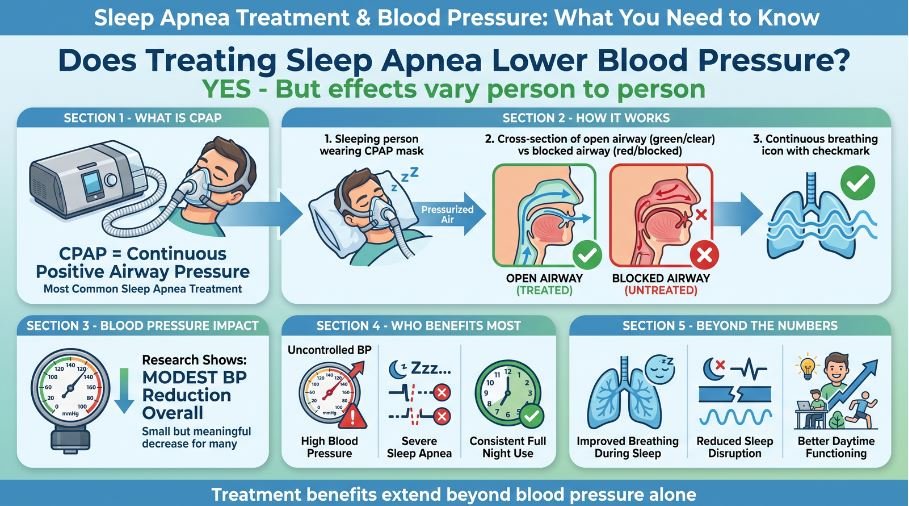
Does Treating Sleep Apnea Lower Blood Pressure?
It can, although the amount varies considerably from person to person.
Continuous positive airway pressure, better known as CPAP, is one of the most common treatments for obstructive sleep apnea.
A CPAP machine delivers pressurized air through a mask while you sleep. The pressure helps keep your airway open so breathing is not repeatedly interrupted.
Research suggests that CPAP generally produces a modest reduction in blood pressure across people with obstructive sleep apnea. The benefit may be greater in people whose blood pressure is uncontrolled, those with more severe sleep apnea, and those who use CPAP consistently for more of the night.
Importantly, treating sleep apnea is about more than lowering a number on your blood pressure monitor. Effective treatment can improve breathing during sleep, reduce sleep disruption, and improve daytime functioning.
How Much Can CPAP Lower Blood Pressure?
There is no single number that applies to everyone.
Large analyses of clinical trials generally find that average reductions are relatively modest, often only a few mmHg.
However, averages can hide important differences between individuals.
People with higher or uncontrolled blood pressure may experience greater reductions than people whose blood pressure is already well controlled. Research also suggests that consistently using CPAP for more hours each night is associated with greater blood pressure improvement.
Nighttime blood pressure may respond particularly well.
Even so, CPAP should not be viewed as a substitute for prescribed blood pressure medication unless your healthcare provider specifically changes your treatment plan.
What Else Can Help If You Have Sleep Apnea and High Blood Pressure?
Managing both conditions often requires addressing several factors at the same time.
Depending on your individual circumstances, your healthcare provider may recommend:
Use Your Sleep Apnea Treatment Consistently
If CPAP has been prescribed, using it regularly is important.
Wearing the device occasionally is unlikely to provide the same benefit as consistent nightly use.
If your mask is uncomfortable or you have difficulty tolerating CPAP, talk with your sleep specialist rather than simply stopping treatment. Adjustments to the mask, pressure settings, humidification, or other aspects of treatment can sometimes make a substantial difference.
Work Toward a Healthy Weight
Excess body weight can increase the risk and severity of obstructive sleep apnea and is also associated with high blood pressure.
For people who are overweight or obese, weight loss may improve both conditions.
Stay Physically Active
Regular physical activity can help lower blood pressure and support weight management and cardiovascular health.
It does not have to mean intense exercise. Even consistent walking can be useful.
We discuss this in more detail in Is Walking Enough to Lower Blood Pressure?.
Pay Attention to Sodium
Sleep apnea is only one potential contributor to hypertension.
Diet still matters.
Reducing excess sodium can help lower blood pressure, particularly in people who are salt-sensitive.
If you’re unsure where most dietary sodium comes from, our guide to how to reduce sodium in your diet offers practical ways to cut back without making your meals bland.
Take Blood Pressure Medication as Prescribed
If you have been prescribed medication for hypertension, continue taking it unless your healthcare provider tells you otherwise.
Treating sleep apnea may improve blood pressure, but it does not automatically eliminate the need for medication.
Your healthcare provider can adjust your treatment if your readings improve.
Should You Check Your Blood Pressure at Home?
Home monitoring can be particularly useful when you and your healthcare provider are trying to understand your blood pressure pattern.
Taking readings at consistent times can help reveal whether your pressure tends to be higher in the morning, remains elevated throughout the day, or responds to treatment.
Remember that blood pressure naturally changes from one reading to another.
Our guide to Why Blood Pressure Changes Throughout the Day explains why those fluctuations happen and which changes deserve more attention.
For suspected nighttime hypertension, your healthcare provider may recommend 24-hour ambulatory blood pressure monitoring. This uses a portable monitor that automatically measures your blood pressure at intervals during both waking and sleeping hours.
It can show whether your blood pressure falls normally at night or remains unusually high while you sleep.
When Should You Talk to Your Doctor About Sleep Apnea?
Consider talking with your healthcare provider if you have high blood pressure along with symptoms such as loud snoring, gasping during sleep, witnessed breathing pauses, morning headaches, or excessive daytime sleepiness.
It is particularly worth discussing if your blood pressure remains above goal despite taking several medications as prescribed.
You may also want to mention any unusual nighttime or morning blood pressure patterns you have noticed at home.
A sleep study can determine whether sleep apnea is actually present. Trying to diagnose the condition based on snoring or blood pressure readings alone is not reliable.
Frequently Asked Questions
Can sleep apnea cause high blood pressure even if I sleep eight hours?
Yes. Sleep apnea affects the quality and physiology of your sleep, not simply how many hours you spend in bed. Repeated breathing interruptions can trigger stress responses and blood pressure surges even if you appear to be getting enough hours of sleep.
Does sleep apnea cause blood pressure to spike at night?
It can. When breathing stops and oxygen levels fall, the sympathetic nervous system becomes activated. Heart rate and blood pressure can rise as the body responds to the breathing interruption.
Can sleep apnea cause high blood pressure in the morning?
Sleep apnea may contribute to elevated morning blood pressure, although there are many other possible causes. Repeated nighttime oxygen drops and nervous-system activation may influence blood pressure patterns that continue into the morning.
Will a CPAP machine lower my blood pressure?
CPAP can lower blood pressure in some people with obstructive sleep apnea, but the average reduction is generally modest. People with uncontrolled or resistant hypertension may experience greater benefits, particularly when CPAP is used consistently.
Can losing weight improve both sleep apnea and high blood pressure?
For people who are overweight or obese, weight loss may help improve both conditions. Excess weight can contribute to narrowing of the upper airway and is also an important risk factor for hypertension.
Can sleep apnea cause resistant hypertension?
Sleep apnea is strongly associated with resistant hypertension and is one of the underlying conditions healthcare providers may investigate when blood pressure remains above goal despite treatment with several medications.
Final Thoughts
Sleep apnea and high blood pressure can reinforce one another in ways that are easy to overlook because much of the problem occurs while you are asleep.
Repeated breathing interruptions can lower oxygen levels, activate your body’s stress response, cause nighttime blood pressure surges, and interfere with the normal drop in blood pressure that should occur during sleep.
The good news is that sleep apnea is treatable.
If you have high blood pressure along with loud snoring, witnessed breathing pauses, gasping during sleep, excessive daytime sleepiness, or blood pressure that remains difficult to control, talk with your healthcare provider about whether sleep apnea could be playing a role.
Finding and treating an underlying sleep disorder may become an important part of getting your blood pressure under better control.